Step into almost any marketing team's office today and the scene is identical - an editor pastes a quick prompt into a web interface, hits enter, and watches a 2,000-word article generate in under half a minute. It looks impressive on the surface. When generative AI writing tools first went mainstream, brands rushed to capitalize on the technology, flooding search engines with automated roundups, superficial how-to guides, and low-effort posts just to capture cheap organic traffic.
And for a minute, it worked. But then the bottom dropped out.
Search engines picked this up quickly. The algorithms were re-engineered to detect mass-produced text, penalize spammy domains with huge ranking drops, and clean up the search results. The reality is tough for enterprise brands today. Of course, machines can churn out facts fast. But relying on them alone kills your domain authority, reader trust, and tanks up your organic traffic. Real, sustainable visibility requires real human thinking. This is precisely why specialized SEO blog writing services are still irreplaceable for serious businesses.
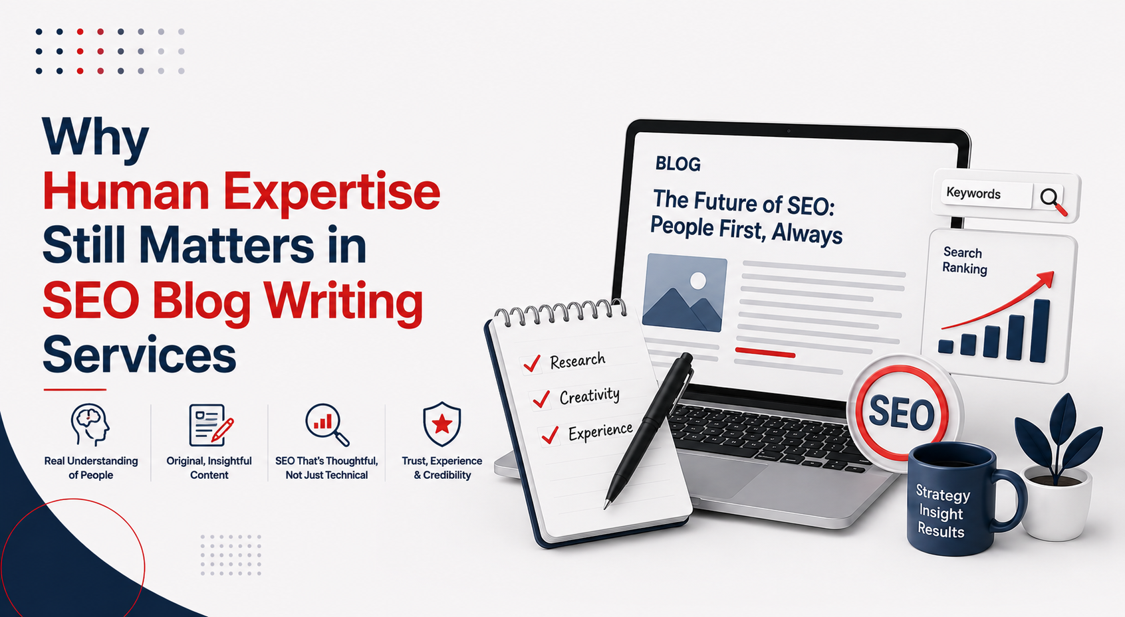
What Google’s E-A-T Standards Mean for Your Website
Google ranks pages based on E-E-A-T - Experience, Expertise, Authority, and Trustworthiness. Artificial intelligence tools are pattern-matching software that stitches together existing web copy. They have zero lived experience. Language models have never delivered a SaaS product, fixed a supply chain, or handled a direct-to-consumer ad budget.
Proving Real Lived Experience
Search algorithms look for obvious signs of real-world knowledge. Hire content writers who really know an industry, and they’ll drop in real case studies, messy operational details, and proprietary data from real campaigns. That kind of proof tells search crawlers your page offers fresh perspective, as opposed to regurgitated fluff.
Building Author Entities
Search platforms map relationships between topics and recognized people. Connecting your articles to real human authors with verifiable bios, LinkedIn profiles, and industry history - creates strong trust signals. Top-tier content writing services make sure every piece carries genuine authority that search engines respect.
Steering Clear of Quality Flags
Automated tools pick words based on mathematical probability, creating predictable text patterns, and repetitive phrasing. Search filters pick up on these signals fast, flagging unedited drafts as low-value copy that drops off ranking pages.
Unpacking Search Intent and Human Psychology
Ranking on page one is not about repeating target keywords over and over. It comes down to decoding search intent - the actual human motivation behind a search bar query.
Reading Between the Lines of a Query
Take a search phrase like “enterprise data migration”. On paper, it looks purely technical. But an experienced human strategist sees the real context - an IT director stressed about system downtime, security risks, and board-level budget pressure. Experienced teams delivering SEO blog writing services write directly to those hidden anxieties, structuring arguments around actual business problems.
Storytelling and Brand Resonance
People make buying choices based on emotion and justify them with logic later. Machines process facts well, but they cannot tell an empathetic story or navigate complex cultural contexts. Strategic content marketing services bring narrative tension, conversational pacing, and genuine tone of voice to technical topics.
A Practical Hybrid Model - Technology Assisted, Human Directed
The debate is not really humans versus machines - it is about using modern software to make human writers sharper and faster. Smart editorial teams use tools like SurferSEO or Clearscope to map out keyword gaps and speed up preliminary research. But the actual voice, analysis, and strategic positioning stay strictly human.
Instead of relying on rigid templates, a modern content strategy agency splits responsibilities based on strengths. Software handles raw keyword gap analysis and basic outline structures. Humans take over the heavy lifting - interviewing subject matter experts to gather unplagiarized insights, shaping brand tone, fact-checking technical claims, and aligning copy with conversion funnels. This blend gives you technological speed without sacrificing quality.
Structuring Content for Generative Search and AI Overviews
Modern search has more than ten blue links on a page. Generative answer engines like Google AI Overviews, Perplexity, and ChatGPT Search simply pull text from web pages to create quick responses for users.
Formatting counts every bit as much as writing if you'd like your site to be cited in those answer boxes-
- Clear Definition Blocks- Put direct, 40-to-50-word answers just below your subheadings for AI tools to pull cleanly.
- Schema Integration- Use proper JSON-LD markup on your site so search engines know who created the content and what entity it is covering.
- Scannable Information- Don't hide facts in dense paragraphs. Separate complex information into short lists and comparison charts.
- Clean Heading Hierarchy- Use a simple, logical structure (H1 for the title, H2s for main points, H3s for supporting sub-topics) so web crawlers can index the page without confusion.
When you nail SEO content creation, you’re setting your brand up to rank in the organic search results and to also be featured in the live AI summaries.
The Invisible Costs of Low-Quality Automation
Shortcuts in content production always incur technical debt down the line. Publishing dozens of unedited machine drafts may boost indexation in the short term, but the long-term penalties are severe. Search engines track how you and your pages are being interacted with. When people click your link, read two paragraphs of generic fluff, and bounce right back to the search results page, algorithms see that behavior as a huge quality failure. The more poor user engagement metrics you have, the worse the rankings will be across your whole domain, not just the automated pages.
Cleaning up poorly optimized AI content costs much more than writing good articles in the first place. When a website is hit with a core helpful content update, you'll have to spend months doing auditing, deleting, and manually rewriting your content. You are paying twice as much for your human strategist. Once to analyze the situation, and again to rebuild your domain authority. And you could have done all that properly from the start with proper strategic oversight.
Four Pillars for Long-Term Search Growth
Sustained organic traffic requires balancing editorial quality with technical hygiene. First, focus on information depth by building comprehensive resources filled with original data and expert quotes to keep readers engaged longer. Second, maintain technical site health by keeping page speed fast and resolving crawl errors in Google Search Console.
Third, implement clean structured data across all published articles to help search algorithms categorize your entity footprint correctly. Finally, schedule regular content audits to revisit old blog posts every few months - updating outdated stats, fixing broken links, and keeping your rankings strong.
A Step-by-Step Action Plan for Marketing Teams
Fixing your content engine does not have to happen overnight, but you need a clear path forward-
- Audit your current library using Google Analytics to find thin or outdated posts that need a human overhaul.
- Establish strict editorial quality gates, so no piece goes live without human fact-checking and tone adjustments.
- Interview with internal product managers, customer support representatives, and sales teams to pull out unique angles.
- Reformat top-performing guides for instant extraction using scannable summaries, direct definitions, and clear bullet points.
- Build out detailed author credentials and bio pages that highlight your writers' professional backgrounds.
Concluding Thoughts
Technology used for the search engines is ever-changing, yet one thing remains consistent - providing the reader with accurate information in an effective and engaging manner. While automated software may make research easier and even draft articles, it can never take the place of thoughtful analysis, emotional insight, and practical industry knowledge.
Utilizing SEO blog writing services will help your company gain an advantage through search engine algorithm changes. With both the technical and human elements combined together in one SEO article, you create a foundation for future success through search engines.