The entire 2025 optimization plan for Zero-Click Search is a comprehensive approach known as Omnichannel Search Optimization, which broadens traditional SEO to include AI-driven results. Marketers must optimize content not only for search engine results pages (SERPs), but also for direct responses and creative summaries.
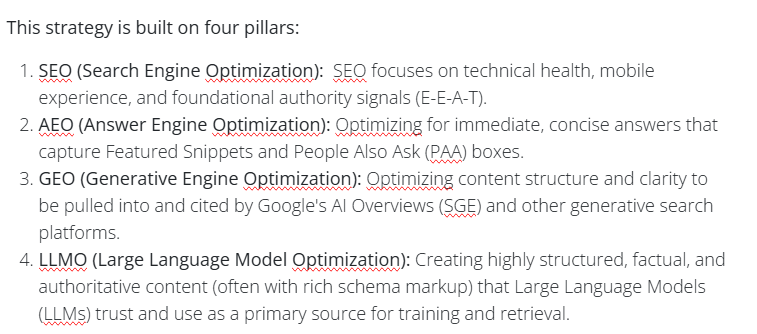
The ultimate goal of this Zero-Click Strategy is shifting focus from measuring website clicks to measuring brand visibility and share of voice in AI-generated responses.
The world of search marketing is no longer defined by a single acronym. As Google and other platforms integrate Large Language Models (LLMs) and Generative AI, marketers are grappling with a new alphabet soup: GEO, AEO, and LLMO.
While Search Engine Optimization (SEO) remains the foundational discipline, the rise of AI-powered answers has created a new competitive playing field.
This comprehensive guide breaks down the nuances of the new optimization acronyms, with a special focus on the crucial distinction: AEO vs SEO. We will show you how to adopt a semantic strategy that ensures your brand maintains visibility and ranks number one in both the traditional SERPs and the new AI-driven answer boxes.
1. The Foundation: Understanding Classic SEO
Before discussing the new terms, it’s vital to reaffirm the role of traditional SEO.
Search Engine Optimization (SEO) is the practice of optimizing your website and content to rank organically in the standard "10 blue links" of search engine results pages (SERPs).
Pillar | Goal |
Technical SEO | Ensure search engines can crawl, render, and index your content efficiently. |
On-Page SEO | Optimize individual pages for user intent and target keywords (titles, headings, meta descriptions). |
Off-Page SEO | Build authority and trust through high-quality backlinks, mentions, and E-E-A-T signals. |
The Core Metric: Click-Through-Rate (CTR) and organic traffic volume. Traditional SEO aims to drive users from the SERP to your website.
2. The Semantic Shift: (Defining the AI Optimization Ecosystem)
The latest wave of acronyms—GEO, AEO, and LLMO—are best seen as specific aspects of AI optimization. They explain various ways for appearing in zero-click, AI-generated search experience components rather than typical organic results.
AEO: Answer Engine Optimization (The Immediate Answer)
AEO focuses on appearing in search results that provide a direct, immediate, and concise answer to a user's query, often preventing the user from needing to click through to a website.
Key Targets:
Featured Snippets, People Also Ask (PAA) boxes, Voice Search results, and the most concise, definitional components of an AI Overview.
AEO Strategy:
Prioritizing conciseness, clarity, and factual accuracy. The content must be organized into self-contained, quotable sections that may be retrieved and confidently presented as the correct answer.
GEO: Generative Engine Optimization (The Synthesized Response)
GEO focuses on optimizing content to be cited and integrated into large, complex, synthesized AI responses, such as Google's Search Generative Experience (SGE) or a detailed summary from ChatGPT/Perplexity.
Key Targets:
The full, multi-paragraph AI Overview or generative response that summarizes multiple sources.
GEO Strategy:
Developing comprehensive, authoritative information with high levels of E-E-A-T (Experience, Expertise, Authority, and Trustworthiness). The idea is to be referenced as a leading source on a topic, even if the user does not visit your link right away.
LLMO: Large Language Model Optimization (The Content Feed)
LLMO is the highest-level concept, focusing on how the underlying language models (LLMs) consume and process your content. LLMO is about making your content machine-readable and structurally ideal for training or feeding AI models.
Key Targets:
Content structure, schema markup, and internal linking.
LLMO Strategy:
Implementing structured data (Schema Markup), using clear semantic HTML (H1, H2, lists), and ensuring your content uses a natural, conversational tone that aligns with how LLMs are trained.
3. Focus Keyword Deep Dive: AEO vs SEO
To rank highly for this topic, marketers must understand the tangible differences between the classic click-driven goal of SEO and the answer-driven goal of AEO.
Feature | SEO (Search Engine Optimization) | AEO (Answer Engine Optimization) |
Primary Goal | Drive clicks and traffic to your website. | Achieve direct citation and visibility in the zero-click result. |
Success Metric | Click-Through-Rate (CTR), Organic Sessions, Conversions. | Being quoted/referenced in a Featured Snippet, PAA, or AI Answer. |
User Search Query | Short, transactional, and broad keywords (e.g., “best email tool”). | Complete, conversational, and question-based (e.g., “Which email marketing tool is best for small businesses?”). |
Content Focus | Optimize the entire page (Title Tag, Meta Description, UX). | Optimize specific passages into 40-60 word, self-contained paragraphs that immediately answer a question. |
The Relationship | The foundation; essential for authority and trust. | A specific, tactical overlay to SEO, focused on capturing instant answers. |
The Key Takeaway for Marketers:
SEO is the prerequisite, whereas AEO is the return. You must first rank high enough in SEO (authority, technical health) for Google's algorithms to trust your content before you can use AEO strategies to capture the coveted response box or highlighted snippet.
4. The Unified Semantic Strategy: How to Win with All Four
To get top exposure in today's search market, you must use a single, unified strategy that includes all four optimization styles. Here's the new Semantic Content Strategy:
1. Master the Question-Answer Format (AEO)
Tactic: Dedicate distinct, clearly marked sections (using H2, H3 headings) to answer common user questions.
Execution: Format the answer immediately beneath the heading in a concise paragraph, followed by detailed supporting information. This "Inverted Pyramid" structure is ideal for AEO extraction.
- Example: H2: What is the difference between SEO and AEO? [40-word Answer Paragraph] [Detailed explanation follows...]
2. Build Structural Authority with Schema (LLMO)
Tactic: Implement structured data (Schema Markup) to clearly label entities, definitions, FAQs, and procedures on your page.
Execution: Schema guides LLMs and search engines in identifying the exact type of information on your page, dramatically increasing the chance of citation and extraction by LLMs.
3. Focus on Citation and Trust (GEO & SEO)
Tactic: Use E-E-A-T signals to build unshakeable brand authority.
Execution: Ensure content is written by a verifiable expert (GEO) and backed by high-quality links (SEO). LLMs prioritize sources that are highly cited and widely trusted when synthesizing a generative response. A single, authoritative sentence from a known expert is more likely to be cited than a paragraph from an anonymous blog.
4. Optimize for Both Clicks and Citations
Tactic: Recognize that AI Overviews often provide a full answer but still link to the source for more detail.
Execution: Write your introductory summary or answer paragraph for the citation (AEO), but ensure the main body of your article is deeply valuable and compelling enough to warrant the click-through from the user seeking confirmation, additional context, or a transactional opportunity (SEO).
Conclusion
The evolution from SEO to a blended GEO, AEO, and LLMO strategy marks a fundamental shift: from optimizing for algorithms to optimizing for answers, clarity, and machine-level comprehension.
The battle for the top spot is no longer just for the #1 organic result (SEO), but for the zero-position answer box (AEO) and the authoritative citation within a generative summary (GEO).
By prioritizing clear, quotable answers (AEO), enhancing structural clarity (LLMO), and building foundational authority (SEO/GEO), you will create content that not only ranks number one in the traditional sense but dominates the entire search landscape.