Why Your Website Is Your Most Valuable Business Asset in 2026
If someone heard about your business today and searched for you online, what would they find?
In 2026, your website is not a digital brochure — it is your 24/7 salesperson, your credibility proof, and often the single deciding factor between a prospect choosing you or choosing your competitor. And yet, the majority of UK small businesses are still operating on websites built five or more years ago, with no mobile optimisation, no clear calls to action, and page speeds that would make a dial-up connection blush.
This guide exists to fix that.
Whether you are building your first business website from scratch, thinking about a full website redesign, or just trying to understand what makes a good website in today's market you are in the right place.
We will walk you through everything: what professional web design actually involves, what website costs in the UK, how to choose the right web development approach for your business, and what the best websites in your industry are doing that yours might not be.
Bookmark this. Share it with your team. It is the only website design guide you will need this year.
Part 1: What Is Website Design — and Why Does It Actually Matter?

Website design is the process of planning, creating, and maintaining the visual layout, user experience, and functionality of a website. But in 2026, it goes far deeper than just 'making it look nice.'
Good website design combines:
• Visual design — colours, typography, imagery, and branding
• User experience (UX) — how easy it is for visitors to navigate and find what they need
• User interface (UI) — the specific elements people interact with (buttons, menus, forms)
• Technical development — the code and infrastructure that makes everything work
• SEO architecture — how the site is structured so Google can find, understand, and rank it
• Conversion design — how effectively the website turns visitors into enquiries, leads, or sales
Miss any of these, and you have an incomplete website, one that might look good but fails to perform, or performs but looks untrustworthy, or ranks but does not convert.
|
The business case is simple: a well-designed website generates revenue. A poorly designed one loses it. |
Part 2: The Core Elements of Professional Website Design
2.1 Responsive Website Design: Non-Negotiable in 2026
Responsive website design means your site automatically adjusts to look and function perfectly on any screen, whether that is a 27-inch desktop monitor, a tablet, or a mobile phone.
In the UK, over 60% of web traffic now comes from mobile devices. Google uses mobile-first indexing, meaning it crawls and ranks the mobile version of your site first. If your website is not responsive, you are not just losing mobile visitors — you are losing rankings across the board.
A professionally designed responsive website will:
• Automatically resize images and text for each device
• Adjust navigation menus for touch screens
• Load fast on mobile connections (4G and 5G)
• Pass Google's Core Web Vitals tests
|
If your website does not pass Google's Mobile-Friendly Test, it needs urgent attention before anything else. |
2.2 Website Speed and Core Web Vitals
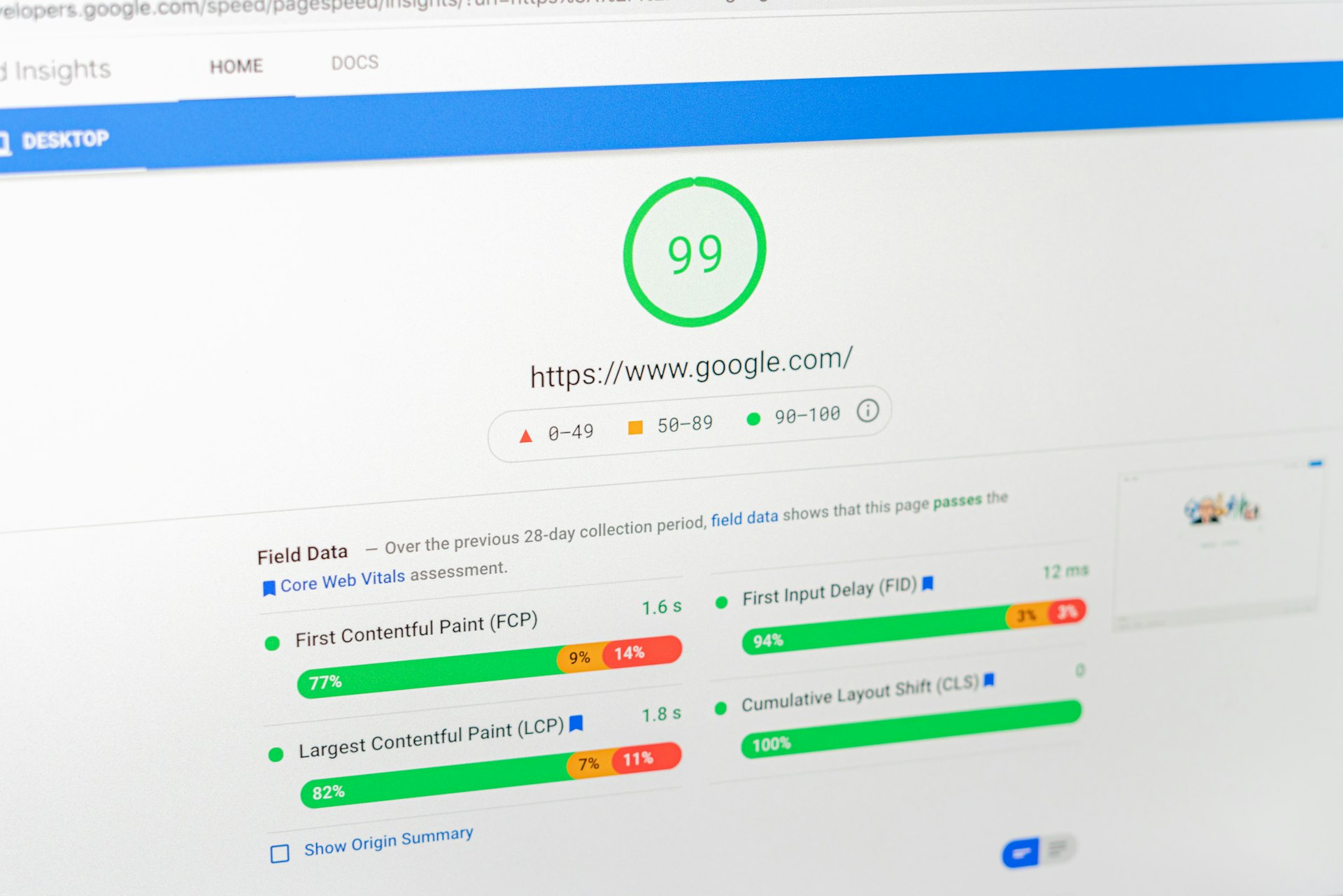
Google officially uses page speed as a ranking factor. Slow websites are penalised in search results, and they bleed visitors: research consistently shows that users abandon a website if it takes more than three seconds to load.
Core Web Vitals — Google's suite of speed and experience metrics — measure three things:
• LCP (Largest Contentful Paint): How quickly the main content loads
• FID/INP (Interaction to Next Paint): How responsive the page feels to user input
• CLS (Cumulative Layout Shift): How visually stable the page is as it loads
A high-quality web development process will optimise all three. If you are working with a web design agency in the UK, ask them specifically about Core Web Vitals performance before signing any contract.
2.3 Clear Navigation and Site Architecture
The structure of your website — how pages are organised and linked together — matters enormously for both users and search engines.
A clear, logical site architecture:
• Helps visitors find what they need in three clicks or fewer
• Helps Google understand the hierarchy and importance of your pages
• Distributes link authority across your site more effectively
• Reduces bounce rate (people leaving immediately)
For most small business websites, a flat structure works best: a homepage, key service or product pages one level below it, and supporting content (blog, about, contact) at the same level.
2.4 Strong Visual Identity and Branding
Your website should look unmistakably like your brand — not like a generic template. In a competitive UK market, the businesses that stand out visually earn more trust, command higher prices, and generate more referrals.
This is where a specialist branding service becomes valuable. If your logo, colour palette, or overall brand identity needs work before your website is built, investing in professional logo design and brand development pays dividends. Services like Sharp Logoz specialise in building the visual identity foundations that a great website is built upon, your logo, typography, and colour system need to be solid before a single page is designed.
2.5 Compelling Copywriting and Content
Design draws people in. Content is what convinces them. Your website copy needs to:
• Speak directly to your ideal customer's problems and goals
• Clearly explain what you do, who you do it for, and why you are the right choice
• Use your target keywords naturally (not stuffed artificially)
• Include clear calls to action on every key page
• Build trust through testimonials, case studies, and social proof
Many small businesses underestimate how much effort good website copy requires. It is worth treating it as seriously as the design itself.
Part 3: Website Development — What It Is and Why It Matters
Website design and website development are related but distinct disciplines:
• Website design is what users see — the visual layer
• Website development is how it works — the code layer
Both matter equally. A beautifully designed website on a poorly built technical foundation will be slow, insecure, hard to update, and difficult to rank on Google. A technically excellent site with poor design will fail to convert.
3.1 Custom Website Development vs. Website Builders
One of the first decisions UK businesses face is whether to use a website builder (like Wix, Squarespace, or Shopify) or invest in custom website development.
Website builders are appropriate when:
• You are a sole trader or micro-business with a limited budget
• Your website is primarily informational with minimal custom functionality
• You want to manage updates yourself without technical knowledge
• Speed to launch is more important than uniqueness
Custom website development is the right choice when:
• You need bespoke functionality that off-the-shelf platforms cannot deliver
• You are building an ecommerce website with complex product logic or integrations
• You want full control over performance, SEO, and scalability
• You are building a long-term digital asset that your business depends on
For most growing UK businesses, custom development on a platform like WordPress, or a fully bespoke build, delivers far better long-term return on investment than a subscription-based website builder.
3.2 The Website Development Process: Step by Step
Understanding the professional website development process helps you work more effectively with your agency, ask better questions, and set realistic expectations.
Stage 1: Discovery and Strategy
Before a single wireframe is sketched, a good web development agency will want to understand your business thoroughly, your goals, your target customers, your competitors, and your existing digital presence. This stage defines the project scope, site architecture, and key performance indicators (KPIs).
Stage 2: Design and Wireframing
Wireframes are blueprint-level layouts that show where content, navigation, images, and calls to action will sit on each page, without the visual design layer. Once wireframes are approved, the visual design phase begins: applying colour, typography, imagery, and branding to create high-fidelity mockups.
Stage 3: Development
The approved designs are built into a functioning website. This involves front-end development (what users see) and back-end development (the server-side logic, databases, and integrations that power the site's functionality).
Stage 4: Content Integration
Copy, images, and other media are added to the site. This is also when SEO fundamentals are implemented, page titles, meta descriptions, structured data, image alt text, internal linking, and URL structure.
Stage 5: Testing and Quality Assurance
Before launch, the site is tested across multiple browsers (Chrome, Firefox, Safari, Edge), devices (desktop, tablet, mobile), and screen sizes. Forms, checkout flows, and integrations are tested end-to-end. Speed and performance are benchmarked.
Stage 6: Launch and Post-Launch Support
The site goes live. A responsible web development agency will monitor the launch carefully, fix any immediate issues, and provide a structured handover with training if you will be managing content yourself.
3.3 Ecommerce Website Development
Building an online store is a significant undertaking with specific requirements beyond standard web development. UK businesses launching or upgrading an ecommerce website need to consider:
• Payment gateway integration (Stripe, PayPal, Klarna, and others)
• Inventory management and how it connects to your stock systems
• Product catalogue structure and filtering/search functionality
• Checkout UX — basket abandonment is one of the biggest revenue leaks in ecommerce
• Shipping logic and returns policy presentation
• Trust signals — security badges, reviews, guarantees
• Tax and VAT compliance for UK and international orders
The agency or freelancer you choose for ecommerce development should have demonstrable experience with the specific platform you are using, whether that is WooCommerce, Shopify, Magento, or a bespoke solution.
Part 4: Website Design Cost in the UK — What Should You Expect to Pay?
One of the most common questions UK business owners ask is: how much does a website cost? The honest answer is: it depends. But here is a realistic breakdown for 2026.
4.1 UK Website Design Price Ranges
• Freelancer (entry level): £500–£2,000 — suitable for very small businesses, sole traders, simple brochure sites.
• Small agency or boutique studio: £2,000–£8,000 — good balance of quality and cost for SMEs.
• Mid-to-large agency: £8,000–£30,000+ — suitable for businesses with complex requirements.
• Enterprise/bespoke build: £30,000–£100,000+ — for large businesses or complex platforms.
4.2 What Affects the Cost of a Website?
• Number of pages and complexity of content
• Level of custom design vs. premium template-based design
• Ecommerce functionality (always increases cost significantly)
• Custom integrations (CRM, booking systems, payment gateways, APIs)
• Copywriting (whether you provide content or the agency writes it)
• Ongoing support and maintenance (monthly retainer vs. one-off project)
• SEO strategy (basic on-page SEO vs. full technical and content SEO)
4.3 The Real Cost of Not Investing in Your Website
• Every week your website is outdated, slow, or poorly converting, you are losing leads
• A single additional client per month, generated by a better website — can pay for a professional redesign within a year
• Poorly built websites often require expensive remedial work, so the cheap option frequently becomes the most expensive one over time
Part 5: How to Choose a Web Design Agency in the UK
5.1 Define Your Goals First
Before you contact a single agency, get clear on:
• What is the primary purpose of the website? (Lead generation? Sales? Brand awareness?)
• Who is your target audience, and what do they need from your site?
• What does success look like — in measurable terms?
• What is your realistic budget range?
• Do you need ongoing support, or just the initial build?
5.2 What to Look For in a Web Design Agency
• Portfolio relevance: Has the agency built websites for businesses similar to yours?
• Process transparency: A professional agency will walk you through their exact development process.
• SEO capability: Design and development without SEO is a half-finished job.
• Communication and project management: Ask how they manage projects and who your contact will be.
• Support and maintenance: What happens after the site launches?
• References and reviews: Check Google, Clutch, and Trustpilot reviews independently.
5.3 Red Flags to Watch Out For
• Agencies that cannot explain their process clearly
• Contracts that lock you out of owning your own website or domain
• No mention of SEO in the proposal
• Wildly low prices with no explanation of what is or is not included
• Poor responsiveness during the sales process
• No post-launch support offering
For businesses that want a proven, results-focused web design and development partner, Design Orbits is worth exploring — their work spans custom development, UX-driven design, and conversion-focused builds for businesses at various growth stages.
Part 6: Website Design Best Practices — The Checklist Every UK Business Needs
6.1 Homepage Design
Your homepage has one job: convince a visitor that they are in the right place and guide them to take the next step. Every effective homepage should have:
• A clear headline that communicates what you do and who you do it for — within three seconds
• A strong supporting statement that elaborates on your core value proposition
• At least one prominent call to action above the fold
• Social proof — testimonials, client logos, awards, or case study previews
• A brief, honest overview of your services or products
• Fast load time (target under 2.5 seconds on mobile)
6.2 Service and Product Pages
Each service or product you offer should have its own dedicated page — not a paragraph on a general 'what we do' page. This matters for two reasons:
• Users get the specific information they need without wading through irrelevant content
• Search engines can rank each page for its specific keyword target independently
6.3 About Page
The about page is one of the most visited pages on most business websites — and one of the most neglected. People buy from people they trust. Include the real story of your business, who is on your team, your values and approach, and photos that show the humans behind the brand.
6.4 Contact Page
Make it embarrassingly easy for people to get in touch:
• A clear, simple contact form (name, email, message — that is all you need)
• Your phone number (click-to-call on mobile)
• Your email address
• Your physical address if you have a location-based business
• A Google Maps embed if applicable
• Response time expectation ('We aim to respond within 24 hours')
6.5 Blog and Content Hub
A regularly updated blog is one of the most powerful tools for building topical authority in your niche and capturing long-tail search traffic. In 2026, Google rewards websites that demonstrate consistent expertise on a topic over time. A site that publishes ten in-depth, genuinely useful articles per year will outperform a site that publishes a hundred thin, generic posts. Quality and relevance always win.
Part 7: SEO and Website Design — Why They Must Work Together
The biggest mistake UK businesses make with website design is treating it as a separate project from SEO. In reality, they are inseparable.
7.1 Technical SEO Fundamentals for UK Websites
Every professionally built website in 2026 should have these technical SEO elements in place from day one:
• HTTPS (SSL Certificate): Google penalises non-secure sites. There is no excuse not to have it.
• Clean URL structure: URLs should be descriptive — /web-design-services/ not /page?id=247
• XML Sitemap: A file that tells Google about every important page on your site.
• Robots.txt: Tells search engine crawlers which pages not to index.
• Structured data (Schema markup): Helps Google understand your content context.
• Image optimisation: Every image needs descriptive alt text and compression.
• Internal linking: Pages should link to each other in a logical, purposeful way.
7.2 On-Page SEO Best Practices
• Title tag: 50–60 characters, lead with the primary keyword, end with your brand name
• Meta description: 130–160 characters, written to earn the click, not just stuff keywords
• H1 heading: One per page, containing the primary keyword naturally
• H2 and H3 subheadings: Structure content logically and include secondary keywords
• Body content: Write for humans first, include keywords naturally at 0.5–1.5% density
• Image alt text: Describe the image accurately, include the keyword where it fits naturally
7.3 Semantic SEO and Topical Authority
In 2026, ranking for a single keyword is less powerful than ranking for an entire topic cluster. Google evaluates how thoroughly a page covers a subject, not just whether it contains certain words.
Topical authority means your website is seen as a comprehensive, trustworthy resource on your subject area. You build it by:
• Publishing interconnected content that covers all aspects of your topic
• Using keyword clusters — groups of related terms around a central theme
• Linking related content together logically
• Being consistent over time
|
This guide itself is an example of semantic SEO in action — by covering website design, web development, costs, agency selection, SEO, and best practices in a single comprehensive resource, it signals topical authority to search engines far more effectively than a short article targeting just one keyword. |
Part 8: Common Website Design Mistakes UK Businesses Make
Mistake 1: Designing for yourself, not your customer
The most common reason websites fail is that they are built around what the business owner likes, not what the customer needs. Your website should reflect your customer's journey, their questions, their concerns, their decision-making process.
Mistake 2: Ignoring mobile
With the majority of UK web traffic on mobile, a site that is not fully optimised for smartphones is losing more than half its potential audience.
Mistake 3: Hiding the call to action
If someone has to scroll to the bottom of a page to find out how to contact you or buy from you, you will lose them. Your call to action should be visible, clear, and repeated throughout the page.
Mistake 4: Slow load speed
Every second of additional load time costs you visitors. Compress images, use a quality hosting provider, implement caching, and regularly test your speed with Google PageSpeed Insights.
Mistake 5: Launching and forgetting
A website is not a one-time project — it is an ongoing asset that needs regular attention. Content should be updated, broken links fixed, plugins and software kept current, and performance monitored.
Mistake 6: Inconsistent branding across the website
Inconsistent use of fonts, colours, tone of voice, and imagery creates a sense of unprofessionalism. This is why investing in professional branding — including logo design from a specialist before your website is built pays off: it gives your design agency a solid visual foundation to build from.
Part 9: The Website Design Checklist for UK Businesses in 2026
Technical Foundation
□ HTTPS/SSL certificate active
□ Mobile responsive design
□ Passes Core Web Vitals (LCP, INP, CLS)
□ Page speed under 3 seconds on mobile
□ XML sitemap submitted to Google Search Console
□ Robots.txt configured correctly
□ Structured data (Schema) implemented
Design and UX
□ Consistent branding (colours, fonts, logo usage)
□ Clear visual hierarchy on every page
□ Navigation is intuitive (no more than 3 clicks to any key page)
□ Clear calls to action above the fold on key pages
□ High-quality imagery (no generic inauthentic stock photos)
□ Accessible design (sufficient colour contrast, readable font sizes)
Content
□ Clear headline and value proposition on homepage
□ Dedicated page for each service or product
□ About page with real people, story, and values
□ Contact page with multiple contact methods
□ Testimonials or case studies visible on key pages
□ Blog or resource section with regular, useful content
SEO
□ Unique, keyword-rich title tags on every page
□ Compelling meta descriptions on every page
□ H1 headings on every page
□ Image alt text on all images
□ Internal linking between related pages
□ Local SEO elements: NAP (name, address, phone) consistent and prominently displayed
Part 10: What Great Websites Look Like in Your Industry
Regardless of your industry, the websites that perform best in the UK in 2026 share the same characteristics:
• Speed: They load fast — on mobile, on slow connections, everywhere.
• Clarity: Within five seconds of landing, visitors know exactly what the business does and what to do next.
• Trust: They show evidence of credibility — testimonials, accreditations, case studies, team photos.
• Functionality: Everything works. Forms submit. Checkout flows complete. Links are not broken.
• Consistency: The brand feels coherent and professional at every touchpoint.
• Content depth: They provide genuinely useful, specific answers to what their audience is searching for.
If your current website does not tick all of these boxes, that is your roadmap for improvement — and it is one worth acting on sooner rather than later.
Final Thoughts: Your Website Is an Investment, Not an Expense
The businesses winning in competitive UK markets in 2026 are those that treat their website as a core business tool — one that is actively managed, regularly improved, and aligned with commercial goals.
A professionally designed, well-developed, and strategically optimised website will:
• Rank higher in Google search results for the keywords your customers are actually using
• Convert more of its visitors into enquiries, leads, and sales
• Build credibility and trust with prospective customers before they even speak to you
• Work for your business 24 hours a day, 365 days a year
Whether you are starting from scratch or overhauling an existing site, if you are ready to build or redesign your website with a team that understands both the technical and commercial dimensions of web development, Optimixia offers the kind of end-to-end service that growing UK businesses need: from strategy and design through to development, SEO, and ongoing support.
And if your brand identity needs work before the website project begins, which it often does, Sharp Logoz provides professional logo design and visual branding that gives your website a distinctive, consistent foundation to build from.
|
Your website should be your hardest-working team member. Make sure it actually is. |